
For the first meeting of our Reading Group Esther McManus (print production tutor & PGR student at UAL) invited us to read Eve Kosofsky Sedgwick‘s seminal essay Paranoid Reading and Reparative Reading (published in her book Touching Feeling, 2003).
Event date: 2 Dec 2025, Camberwell
Words by Esther McManus

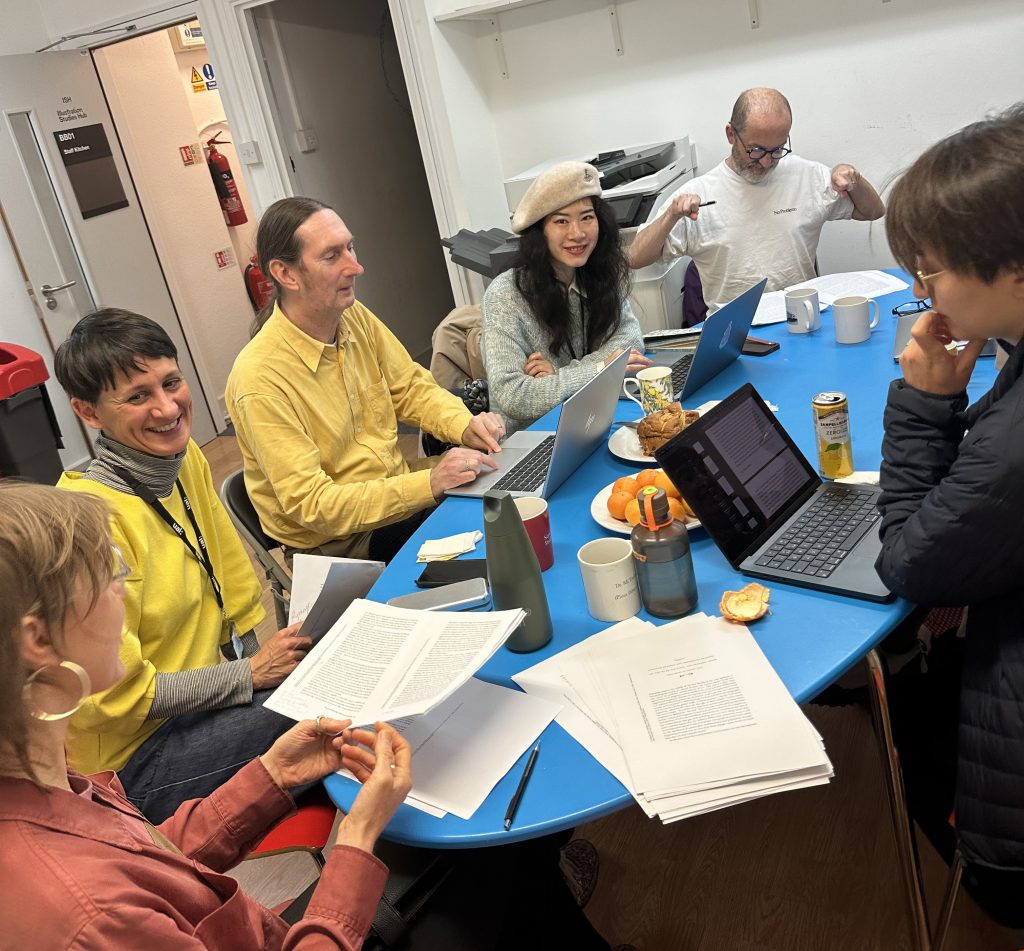
On 2nd December, the inaugural ISH Reading Group met to discuss Eve Kosofsky Sedgwick’s Paranoid Reading and Reparative Reading.
After suggesting the essay a few months ago, I was looking forward to discussing this dense, humorous text with the group. Paranoid Reading and Reparative Reading is constantly referenced in the literature for my PhD, from texts about queer history and historiography (Halperin, 2007; Doan, 2015), to queer comics and reading queerly (McCullough, 2018). When I eventually spent time with the text itself, I was struck by the breadth of disciplines that Sedgwick draws from: psychoanalysis, new historicism, queer theory, English literature, etc, etc… This breadth, and the text’s implications for knowledge and interpretation, made it an appealing choice to discuss with others.
Over tea, oranges and panettone we settled in with a round of introductions and then began to discuss our thoughts, experiences and interpretations…
The text itself:
For the benefit of all present, we collectively crafted a synopsis of the text’s key ideas. The majority of it outlines paranoid reading, which Sedgwick suggests has become the dominant (perhaps even exclusive?) mode of ‘critical’ reading and interpreting texts. This mode is typified by picking apart texts to reveal their ‘true’ meaning, and a faith in this reveal’s ability to provoke action. We had some interesting responses to this, as so-called paranoid reading was the only way many of us had been taught to construct knowledge (“but isn’t this the only way to be critical?!”) Even so, we were generally excited by Sedgwick’s genealogy of ‘the paranoid position’, which is presented as a challenge to it.
We moved on to her alternative reparative mode of reading: approaching a text with openness, rather than overshadowing it with one motivation. This offers the potential for multiplicity, something more productive than the singular paranoid reading. I find Sedgwick’s example of the difference between a paranoid and reparative reading of ‘camp’ illuminating here: the perceived deficit in Butler’s paranoid reading of camp (in Gender Trouble, 1990) is transformed into a reparative perception of camp’s pleasure and creativity by Sedgwick.
This description of reparative reading struck a chord with the group: there were some questions about what this might look like in practice, but ultimately we speculated that illustration research might support exactly this kind of enquiry and interpretation. The openness and multiplicity of illustration methods/outcomes resists a singular ‘reveal’, supporting multiple interpretations and meanings.
There was a suggestion that this would be a valuable way to approach archives too: preconceived ideas about what you want to find (and reveal!?) in an archival collection can obscure what’s actually there, and limit the multiple interpretations that could be made.
Style and presence:
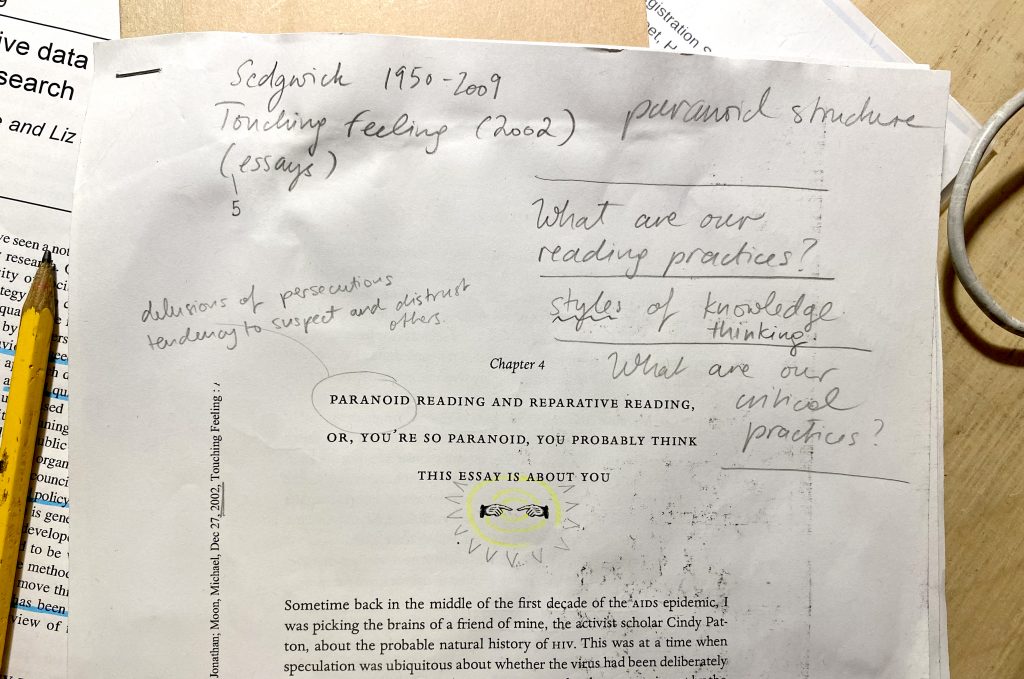
Beyond the content of the text itself, there was admiring discussion of Sedgwick’s writing style: the dazzling prose of someone at the top of her game. The numerous ‘HA!’s annotating our print-outs showed, at a glance, her ability to bring humour to serious work. It brought to mind another expansive, hilarious, influential text: Donna Haraway’s Situated Knowledges.
Sedgwick is creative with her arguments, and also her structure. She deftly brings in memory, anecdotes and fictionalised vignettes to illuminate her (sometimes quite abstract) arguments. These moments make the writing forceful and clear, and offer insight into why she might take these positions: her lived experience of breast cancer and the premature loss of friends to AIDS renders mainstream logics of futurity irrelevant. A different logic is necessary, and actively practiced here.
Our discussion of Sedgwick’s writing led to reflection on how we bring ourselves into our work. Several members of the group gave examples of their PhD research, yet there was a general sentiment that writing about yourself can feel…wrong!? Many of us have been trained to eschew the first person in favour of a (fraudulent) neutrality, and find it uncomfortable to speak in a more personal voice. Despite this, there was acknowledgement that personal writing can lend weight to our research: it’s valuable to share our journey with the reader, so they can understand the significance of our new knowledge. A final, useful tip was offered about the importance of consistency here: if you suddenly stop using your personal voice, your reader will feel abandoned!
Why and how we read:
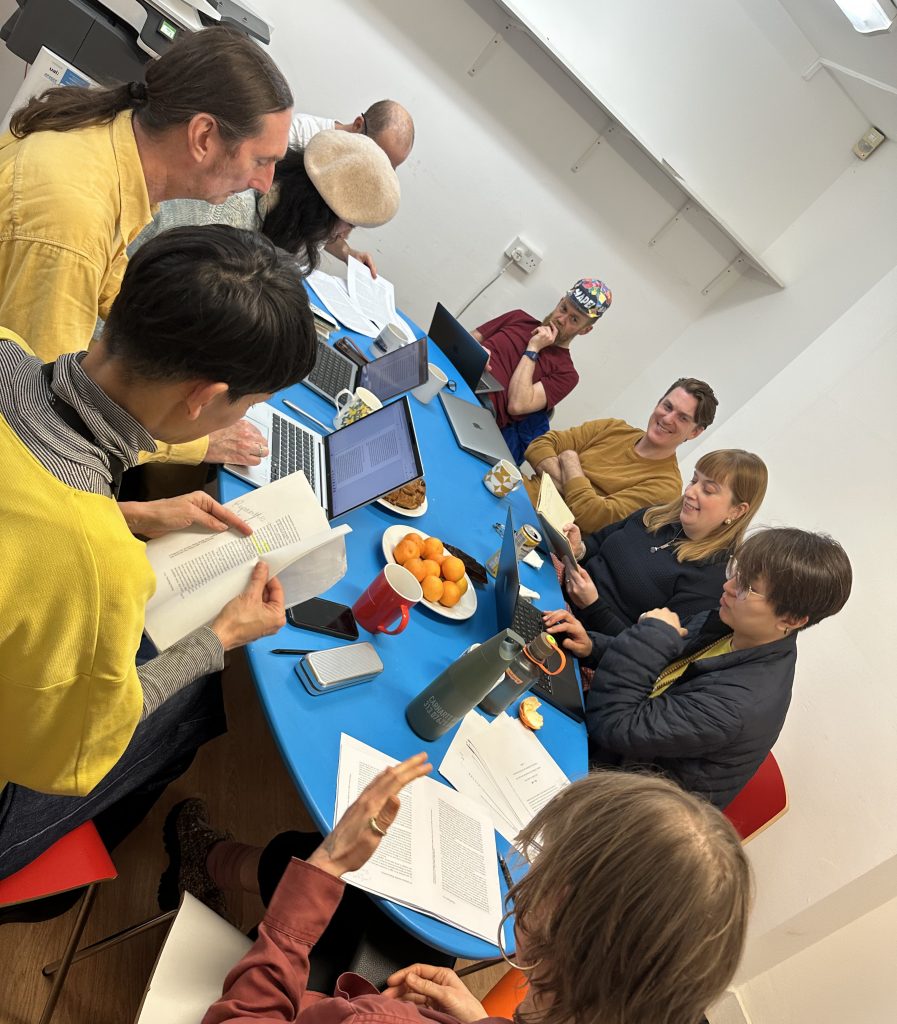
We ended the session by speaking more generally about reading for research, particularly in the context of PhDs: how do we know what to read, and how much? There were different perspectives on this, from only reading what’s strictly usable, to only stopping when you’re bored. Vernon Trafford’s lectures were recommended as a helpful guide for reading and working strategically.
There was interesting speculation on whether the broad-based nature of illustration and comics makes them well-suited to roving, tangential reading. Many of us found that illustration offered several routes back to the main topic of research, even if we strayed from the path. Finally, there was an insightful discussion on the difference between a research topic and its subject/discipline. We noted that it’s important to be familiar with a discipline’s discourse (e.g. branding), not just the disparate contexts where this discipline might be applied (e.g. products marketed at women).
As we drew towards the end of the session (the smell of mixed peel lingering in the air, the night setting in), our conversation became metaphor-laden and dreamy:
Is comics studies a wobbly chair? Or a woven hammock?
Is a PhD a dark tower, always looming in the periphery? Or is it a beloved cat that we caress throughout the week?
And out into the dark night we went, full of cheer and inspiration: “good luck with assessment!”, “safe travels!”, “see you at the next ISH in February!”
Go back
References that came up in discussion:
Butler, J. (1990) Gender Trouble: Feminism and the Subversion of Identity. New York: Routledge.
Doan, L. (2013) Disturbing practices: history, sexuality, and women’s experience of modern war. Chicago London: The University of Chicago Press.
Duncan, R. & Matthew J. Smith, Eds. (2017) The secret origins of comics studies. New York: Routledge.
Halperin, D.M. (2007) How to do the history of homosexuality. Chicago: University of Chicago Press.
Haraway, D. (1988) “Situated Knowledges: The Science Question in Feminism and the Privilege of Partial Perspective.” Feminist Studies 14, no. 3: 575–99.
McCullough, K. (2018) ‘“The Complexity of Loss Itself”: The Comics Form and Fun Home ’s Queer Reparative Temporality’, American Literature, 90(2), pp. 377–405.
Sedgwick, E.K. (1990) Epistemology of the Closet. Berkeley: University of California Press.
Sontag, S. (1964) “Notes on ‘Camp’”, Partisan Review
Trafford, V. & Shosh Lesham (2008) Stepping stones to achieving your doctorate. Maidenhead, Open University Press.