
For the second meeting of our Reading Group Dr Haiqi Yang invited us to read Jaleen Grove‘s recent article ‘What is illustration? A shadowy definition for illustration research‘ published in The Journal of Illustration, Vol 11, Issue 1, 2024.
Event date: 21 April 2026, Camberwell
Words by Matt O’Rourke, freelance illustrator and writer, MA Illustration graduate, Camberwell (UAL)
Photographs by Nerijus Malinauskas

It was 4:05pm on a sunny Tuesday afternoon when I got off the bus to make my way to the Illustration Studies Hub reading group. I was a little early, so I thought I’d spend 20 minutes or so in the park and pass the time by reading over another book I was on at the moment. It was Invisible Cities by Italo Calvino, a book set around the imagined observations of Marco Polo’s visits to various cities, exploring ideas about how we perceive the world and the places we construct in our minds. Slowly it occurred to me that it offered an interesting juxtaposition to the essay we would be discussing later. A central theme that Marco Polo keeps returning to is his reluctance to use words to define the exact realities of places, choosing instead to construct imaginary places that offer room for interpretations and feelings, that do not restrict what the mind might conjure.
“Memory’s images, once fixed in words, are erased.” (1972: 87)
These ideas stayed with me as my thoughts wandered to the text we would be discussing today: ‘What is Illustration? A shadowy definition for Illustration research’, by Jaleen Grove, published by the Journal of Illustration (2024, 11:1). The text pushes the classic idea of an illustration that illuminates into something much murkier, something shadowy. I was skeptical of the value in defining illustration. I wondered if by doing so words might be built up as walls around us, if this would be a definition that might cast a shadow over other imagined possibilities, like in Invisible Cities where words will always fail to offer a true representation.
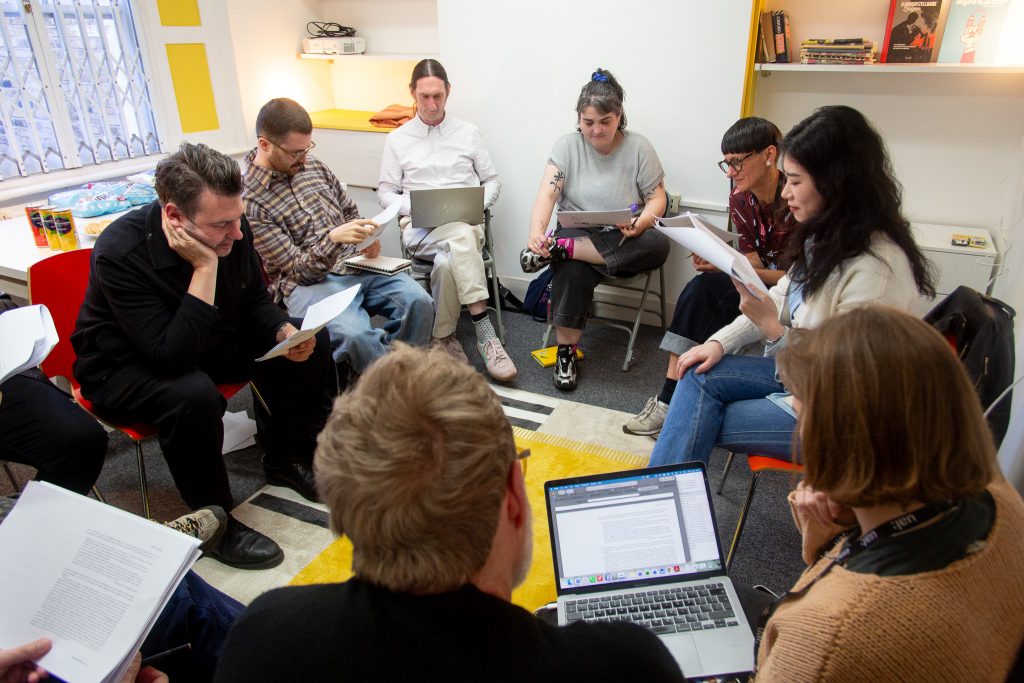
Illuminating:
The text elegantly explores proto-Indo-European roots of the word illustration. Here illustration is frequently defined as something that seeks to illuminate, bring clarity and enlighten – these are traditional ideas of Illustration. Grove inventively pushes this much discussed idea and goes further to explore not just what can be illuminated by it, but in doing so what kind of shadow is cast – what is un/intentionally obscured. Furthermore, we learn about how for some, illustration can be something that takes place within these shadows, as something intentionally foggy, where illumination might mean misrepresentation or appropriation.
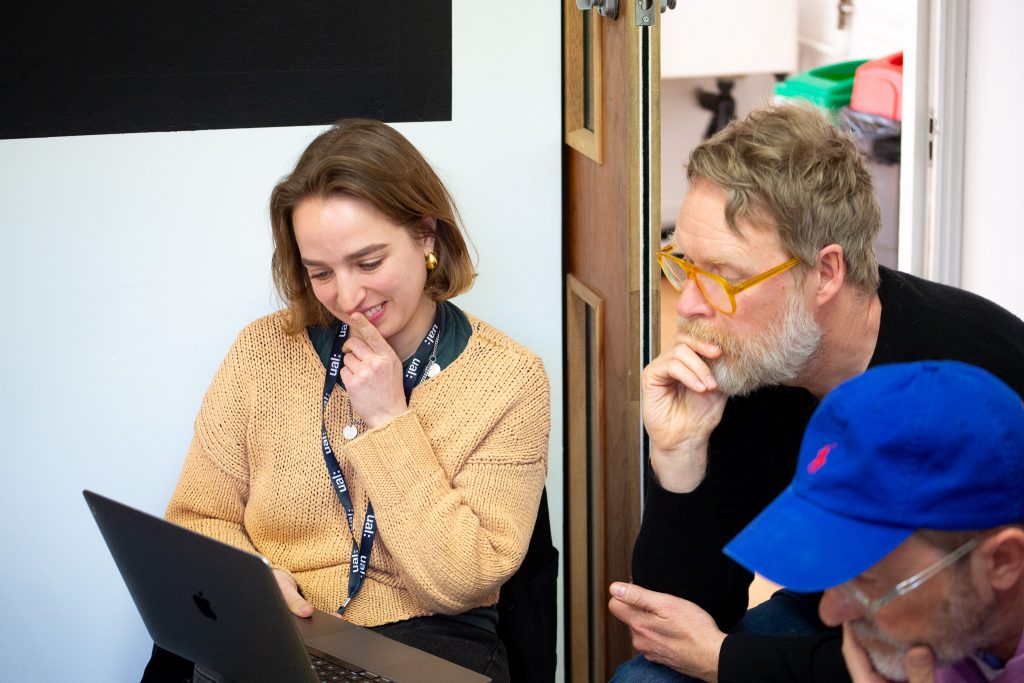
Collaboration through discussion:
Haiqi Yang had structured the discussion by dividing the reading into three parts. We began by going round the circle, each reading a sentence from a part of the first section. Perhaps we were collaboratively constructing the text together? I thought back to the talk a couple months ago about collaboration in illustration…
We read about more historical ideas, starting with the dictionary description of Illustration which focuses on it being something commercial, often coming from a book or newspaper. We shared thoughts on our own initial understandings. Was illustration really only something that responds to text? These narrow ideas have long since shifted, and many agreed that what gave illustration some of its edges was that it is relational, it is always working with/against another discipline, story or idea, and this doesn’t have to always be text. We all agreed that any definitions we sketch out are constantly in flux.

The next section focused on an anecdote from Grove around an experience with a student questioning the necessity of viewing ‘triggering’ visual material from history, in order to gain understanding of the past, and observe a criticality towards it. This perhaps provoked the most differing viewpoints of the evening, each of us unsure how to navigate our own responses. We heard anecdotes of people who had encountered similar situations: tutors sharing sensitive comic books, somewhat cynical thoughts on students encountering ‘difficult’ images, and the experiences some of our group had as students, where they felt they were unnecessarily exposed to traumatic content. Grove highlights this in the text by citing the trauma that can be provoked in refugees when exposing them to certain images. Though we were a mixture of educators, students, practitioners and graduates, it felt important to have an equal say in how this scenario could be navigated. However, our discussions perhaps failed to reach a conclusion. What was agreed is that in these scenarios it was always important to contextualise the work.
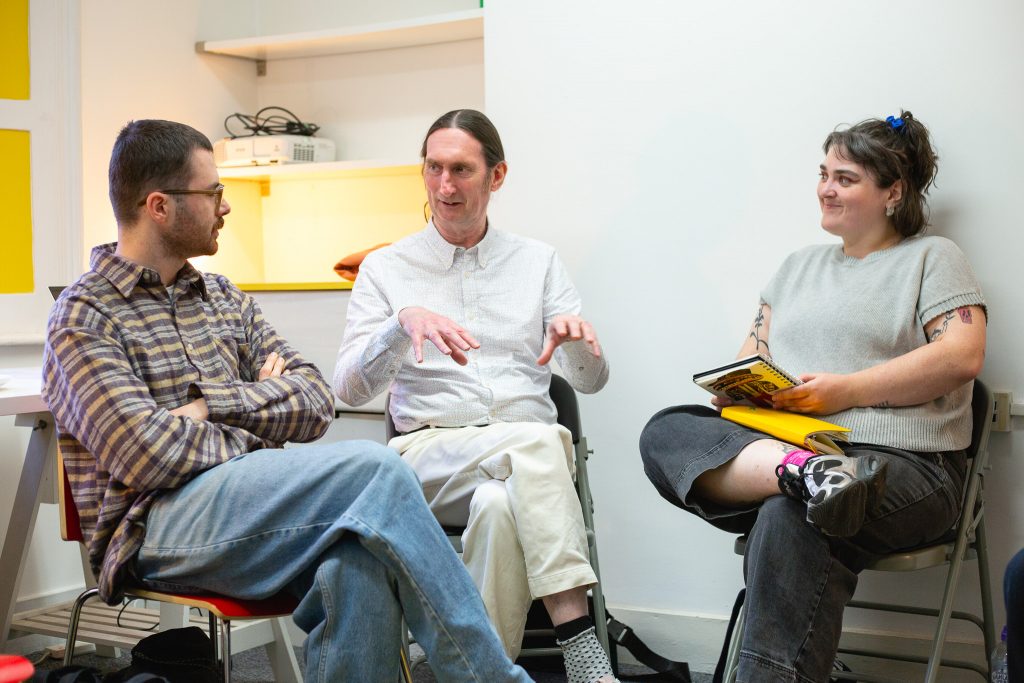
We then discussed Groves’ attempt at providing a definition of illustration that offered openness to include these shadows as well as illustration’s more tangible attempts at communicating. The group largely found elegance in this definition, satisfied that there was room left for practitioners to push against. It kept the edges murky and there was an openness which did not restrict illustration to something visual, or its need to be strictly responsive to text:
“Illustration: A creative production that intends to communicate data, sensations, concepts, and values through material or imagined manifestations for the purposes of deepening knowledge, awareness, and sensory experience” (Grove 2024: 40).
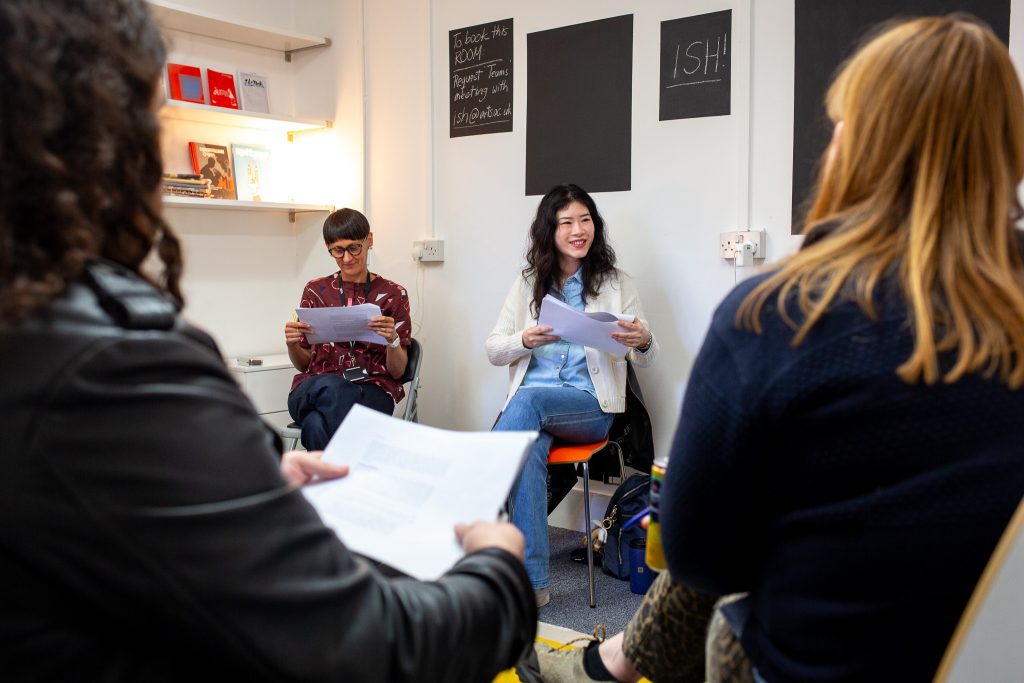
Understanding these boundaries:
I still sensed some uncertainties as I thought back to Calvino’s Invisible Cities. Though this was indeed an open-ended definition, with room to explore, I wondered if by solidifying this “creative production” we have cornered it into something, and closed off its borders when before they were open to be explored endlessly. I decided to put my question to the group: “Why is it important to have a definition for illustration?”
Quiet, and then a few looks shot across the room. I took a bite of shortbread. I was intrigued about what the group of researchers, lecturers, writers, students, illustrators and graduates might come up with, and slowly, answers emerged. For some, seeking a definition was more about giving yourself edges to push against, a point at which new creativity can start from. Others shared that it is important to have a definition for an academic area of study which often gets overlooked (such as illustration), and how this was a definition for illustration research. A definition for illustration would be even murkier. It was also highlighted how this description was only a container of thoughts at present, that would likely shift, merge and move into other areas over time, always responding to the present climate and growing future possibilities.
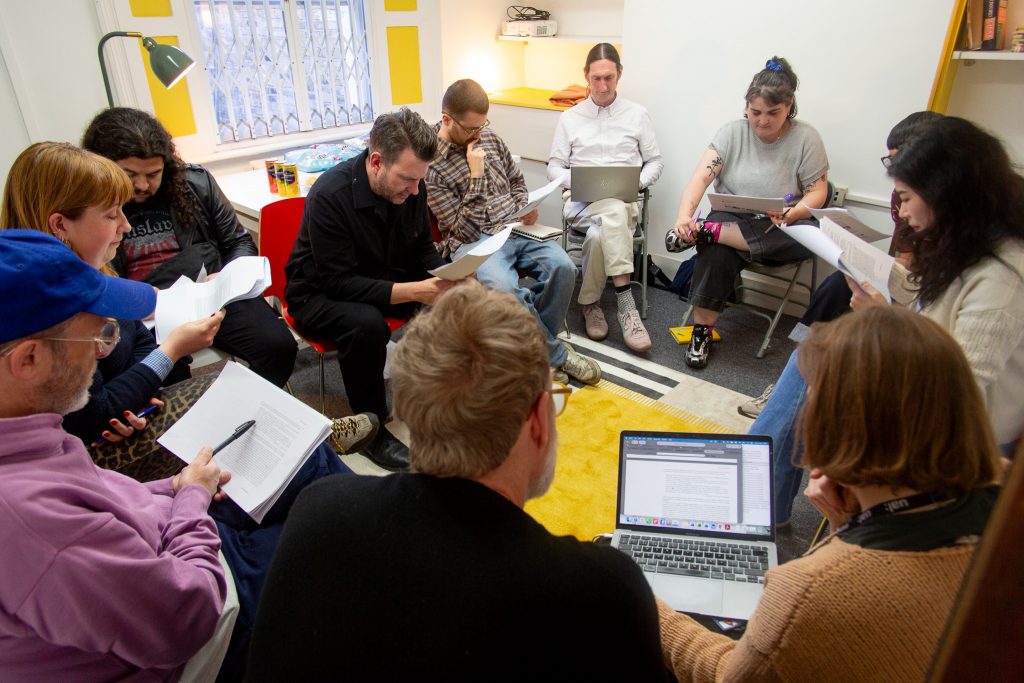
This discussion then shifted to how this text focused on the proto-Indo-European roots of the word illustration, using other languages as a starting point for an etymological investigation would have produced other outcomes. Haiqi shared how the roots of the Chinese word for Illustration came from something that is situated with text, originally in books. It was interesting to speculate how different definitions might arise when not necessarily constraining a definition to one particular origin.
It seemed that the seeking of a definition was the important part for us, and it was mainly needed as a way of being critical about our practice. In seeking those edges, the goal was to question rather than arrive at a conclusion. I felt satisfied and invigorated by this idea, that through this definition, we had not given borders to this discipline, only located its coordinates, and we were now free to roam into any direction from this starting point.
I got back on the bus home, and returned to the strange world of Calvino. In a different section he was constructing an unusual, fantastical city, suspended in the sky. I drifted away into the dreamy prose and enjoyed this sense of not knowing where the ideas were taking me, what parts were real, and what parts could simply be enjoyed as a shadowy space for my mind to wander.
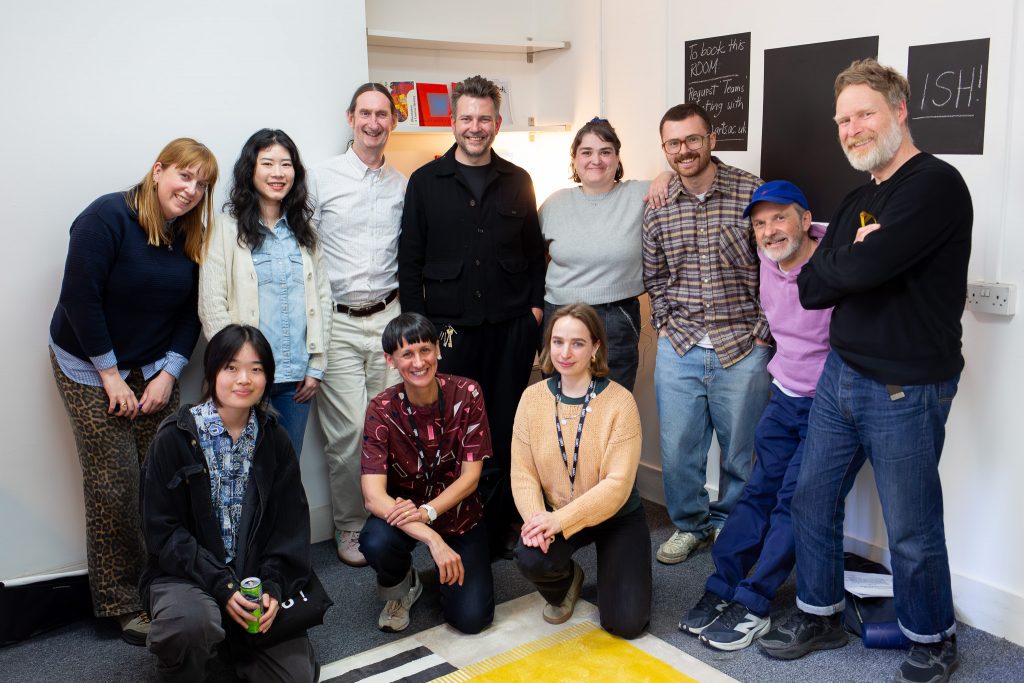
Front row, from left to right: Yu, Luise, Rachel.
References:
Calvino, I. (1972) Invisible Cities. London: Vintage.
Grove, J. (2024) ‘What is illustration? A shadowy definition for illustration research’, Journal of Illustration, Special Issue: ‘Illuminating the Non-Representable’, 11:1, pp. 21–44, https://doi. org/10.1386/jill_00083_1